Skip to content
Lexington Foundation Repair

Serving Lexington and nearby areas

Cracks in Brick in Lexington, KY

Cracks in the brick on a Lexington house can be worn mortar or a settling corner, and a free inspection tells you which one before you pay for either fix.

Book a free foundation inspection

Tell us what you are seeing. A local specialist calls you back the same business day.

Local to Lexington

We connect property owners in Lexington and nearby areas, including Gratz Park, Ashland Park, Chevy Chase, Hamburg, Nicholasville and Georgetown, with one independent local foundation repair specialist.

  • Soil that breaks masonry

    The Kentucky Geological Survey warns that swelling soil under a foundation can push a house out of plumb and shatter masonry and windows if nothing is done.

  • Clay under the lawn

    Maury soil, common across the Inner Bluegrass, has a clay-rich subsoil. It swells when wet and shrinks when dry, which moves a footing a little each season.

  • Old mortar

    About 6.8 percent of Lexington homes were built in 1939 or earlier. Mortar that old often wears out on its own, with or without foundation movement.

What it costs

Typical published ranges for Lexington. The contractor's written estimate is the price, and the inspection is free.

WorkTypical range
Inspection and written estimate Free
Tuckpointing (new mortar in worn joints) $5 to $25per sq ft
Seal or inject one foundation crack $200 to $1,000
Steel or helical pier under a sinking corner $1,000 to $3,000per pier
Structural engineer report $300 to $2,000

See typical foundation repair prices in Lexington

What brick cracks look like

Brick is stiff. When the ground under it moves even a little, the brick cannot bend, so it cracks. Where and how it cracks tells the story.

Stair-step cracks

A zigzag line that follows the mortar joints up and over, like steps. This is the most common one.

Cracks through the brick

A straight crack that splits bricks in half, not just the mortar.

Cracks at windows and doors

Cracks that start at the corner of a window or the top of a door.

A gap at the trim

Brick pulling away from a window frame, door frame or garage opening.

A gap at the corner

A vertical crack near the corner of the house, wider at the top or the bottom.

Bricks that stick out

A section of brick that bulges out or leans away from the wall behind it.

Loose, sandy mortar

Mortar that crumbles when you scrape it with a key.

Why brick cracks in Lexington

There are two common causes. One is the ground. The other is just age.

The ground moves. Most Lexington homes sit on clay-rich soil over limestone. Maury soil, common across the Inner Bluegrass, has a subsoil of silty clay loam to clay. Clay swells when it is wet and shrinks when it dries. The Kentucky Geological Survey warns that swelling soil can push a house out of plumb and shatter masonry if nothing is done. A corner that gets more water, like one next to a downspout, can move more than the rest of the house. The brick above it cracks.

The ground can wash out. Lexington also sits on karst, limestone with gaps and channels. Soil can slowly wash into those gaps under a footing. That corner sinks, and the brick above shows it first.

The mortar is old. About 6.8 percent of Lexington homes were built in 1939 or earlier. Mortar that old can crack and crumble just from weather. That is a mortar problem, not a foundation problem, and it costs much less to fix.

When it is cosmetic and when it is urgent

Likely cosmetic. Hairline cracks in mortar only. Cracks that do not grow over a year. No matching cracks or sticking doors inside.

Book an inspection soon. Stair-step cracks you can fit a dime into. Cracks wider at one end. Cracks that line up with drywall cracks or a sticking door inside. Brick pulling away from a window frame.

Call right away. A crack that opened fast. Bricks that bulge or lean out. A crack that keeps growing month to month. A corner that has visibly dropped.

How brick cracks get fixed

The inspector first decides if the house is still moving. That one answer sets the whole plan.

If it is only the mortar. Worn joints are ground out and filled with fresh mortar. This is called tuckpointing. The color can often be matched so the patch blends in.

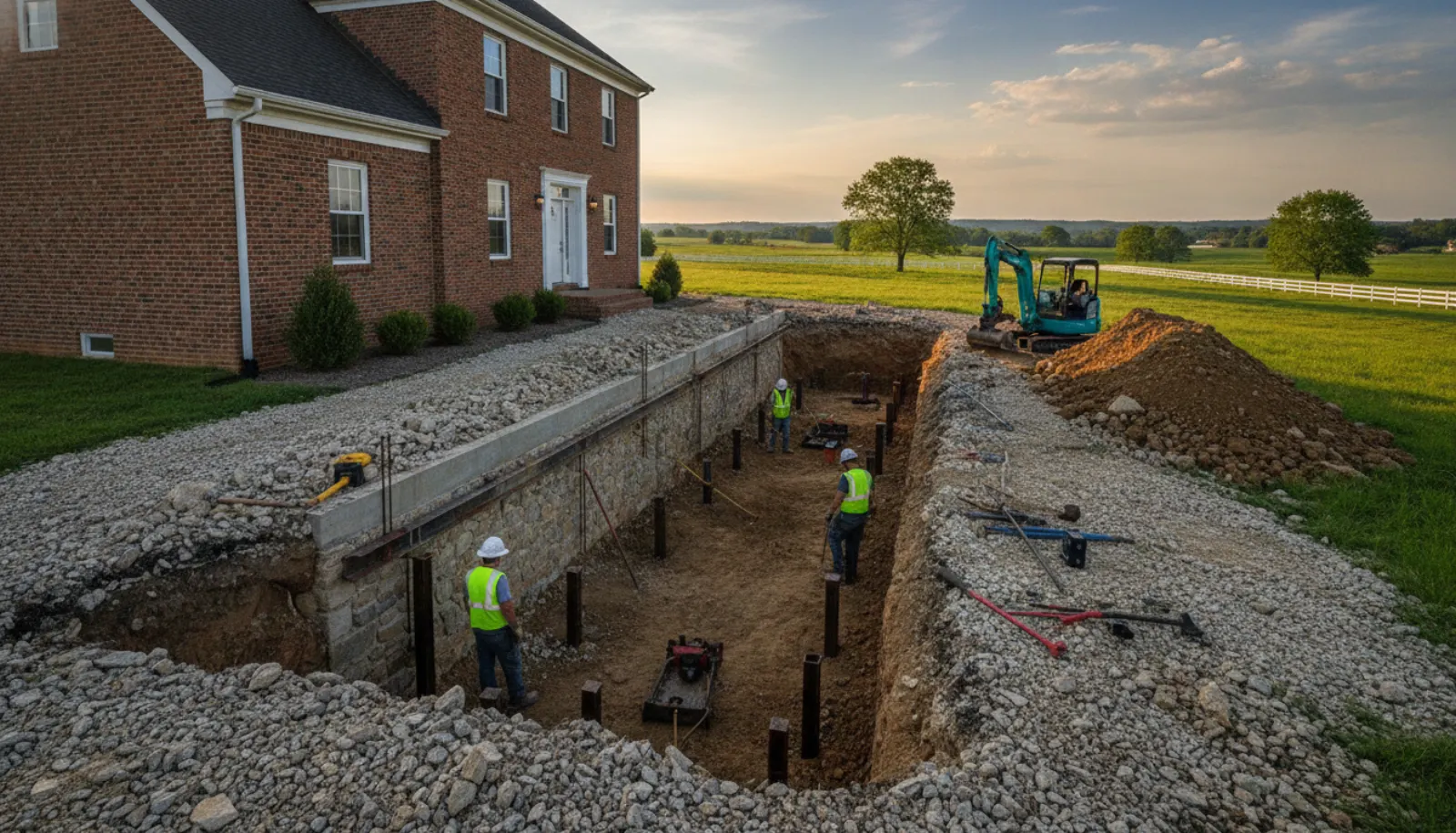
If the corner is moving. The movement gets fixed first, then the brick. Steel piers can be set under the sinking corner, down to firm soil or rock. Drainage fixes, like moving a downspout, take water away from that corner. Once the footing is stable, the brick is repointed or the cracked bricks are replaced.

If the brick is leaning out. A bulging section may need to be tied back to the wall behind it or taken down and relaid.

Fixing the brick without fixing a moving footing usually means the crack comes back.

What it costs

The table shows typical ranges from national cost guides. Tuckpointing is priced by the square foot of wall. Pier work is priced by the pier. Your written estimate will say which you need.

What to do before the inspection

  1. Take a photo of each crack with a coin or tape in the shot for size.
  2. Mark the ends with a pencil and write the date.
  3. Check inside on the same wall for drywall cracks or sticking doors and windows.
  4. Look at the downspout nearest the crack. Point it away from the house.
  5. Check again after a few weeks of wet or dry weather and note any change.

Frequently asked questions

Are stair-step cracks in brick always a foundation problem?

No. Old mortar can crack on its own. Stair-step cracks that are wide, growing, or wider at one end, or that line up with cracks inside, point to a footing that has moved.

Can I just fill the brick crack with mortar or caulk?

You can, and it keeps water out. But if the corner is still sinking, the crack will come back. Find out if it is moving first, so you only pay once.

My brick is pulling away from the window frame. Is that serious?

A gap between brick and a window or door frame often means that part of the wall has dropped. It is worth an inspection, especially if the window also sticks.

Do brick cracks hurt my home's value?

Buyers and their inspectors notice them. A crack with a written report that says it is cosmetic, or a repair with a warranty, is far less of a worry than one nobody checked.

Why did the cracks show up after a dry summer?

Clay soil shrinks when it dries out. That can let a corner of the house drop a little. Cracks that open in late summer and close in spring are a sign of this.

Call (859) 681-6936 or send the short form to book a free inspection of the cracks.

(859) 681-6936 Free inspection