Skip to content
Lexington Foundation Repair

Serving Lexington and nearby areas

Foundation Repair in Georgetown, KY

Foundation repair for Georgetown homeowners, with a free inspection and a written price from a local crew that works across Scott County.

Book a free foundation inspection

Tell us what you are seeing. A local specialist calls you back the same business day.

Local to Lexington

We connect property owners in Lexington and nearby areas, including Gratz Park, Ashland Park, Chevy Chase, Hamburg, Nicholasville and Georgetown, with one independent local foundation repair specialist.

  • A town that doubled fast

    Georgetown grew from 29,098 people in 2010 to 37,086 in 2020. About 54 percent of its homes were built in 2000 or later.

  • Homes that sit on soft clay

    State geologists warn that some Scott County homes rest partly on soft clay instead of rock, which can cause slow settling.

  • Sinkholes are very common

    The Kentucky Geological Survey says sinkholes are very common in the upper Lexington Limestone in Scott County, with the large ones in the Grier Limestone.

  • A town that drinks from the rock

    More than 13,000 Georgetown water customers rely on Royal Spring, a spring that flows out of the karst rock under the town.

What it costs

Typical published ranges for Lexington. The contractor's written estimate is the price, and the inspection is free.

WorkTypical range
Inspection and written estimate Free
Seal or inject one crack $200 to $1,000
Steel or helical pier $1,000 to $3,000per pier
Lift a sunken slab (mudjacking) $500 to $1,900
Bowing wall repair, whole job $4,000 to $15,000
Structural engineer report $300 to $2,000

See typical foundation repair prices in Lexington

Foundation repair for Georgetown homes

Georgetown is the Scott County seat, about 16 miles north of downtown Lexington on I-75. Settlers came here in the 1780s for Royal Spring. Toyota picked Georgetown in 1985 and opened its plant in 1988. That set off the biggest growth in the town's history.

The numbers show it. Georgetown went from 29,098 people in 2010 to 37,086 in 2020. About 54 percent of the homes in town were built in 2000 or later. Only about 1 in 20 was built in 1939 or earlier.

So most Georgetown foundation calls come from fairly new homes on the edge of town. A smaller number come from the old houses near downtown and Georgetown College.

The ground under Georgetown

Georgetown sits on the line between the Inner and Outer Bluegrass, at about 840 feet. Under the yard is clay. Under the clay is limestone that water has worn into channels and caves. The Kentucky Geological Survey lists Georgetown among the Kentucky cities that sit partly or fully on this karst rock.

The town even drinks from it. More than 13,000 water customers rely on Royal Spring, which flows out of that rock right downtown.

State geologists name the risks for Scott County homes plainly:

Soft clay under part of a house

Some homes rest partly on soft clay instead of rock. That side settles slowly over the years.

Soil washing into the rock

Water from drains and fill around a house can carry soil down into gaps in the limestone. That leaves a soft spot under a footing.

Sinkholes that drop

Soil over a channel in the rock can settle for years, then collapse and wash out fast.

Swelling clay

Wet clay can push on walls and footings with several tons per square foot.

Hidden seeps

Water that runs along the top of a rock layer can show up as a wet basement or soft ground. It is often missed if the house was built in dry weather.

Problems that come up most in Georgetown homes

Settling in newer homes. A house built in the 2000s or 2010s sits on soil that was dug out and packed back. That fill can sink. Look for cracks over doors and windows, a gap where drywall meets the ceiling, or a garage floor that has dropped.

Basement wall cracks and leaks. Many newer Georgetown homes have poured basements. A thin crack from curing is common. A crack that leaks, grows wider or is wider at the top points to soil pressure or settling.

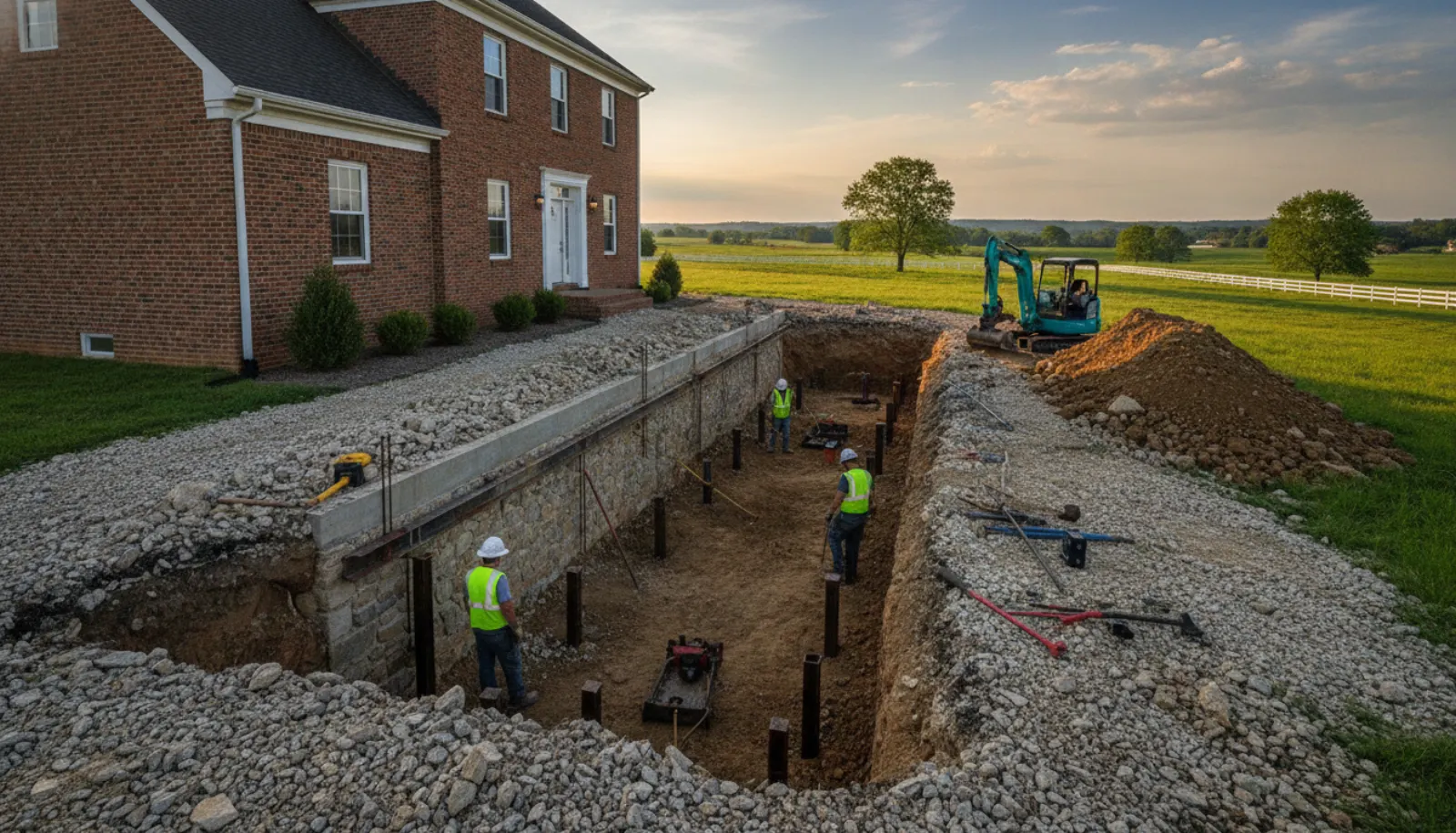
Sinking corners near sinkholes. On lots with a sinkhole or a low spot nearby, one corner of the house can sink as soil washes into the rock. Steel piers are the usual fix. They reach down past the soft soil to firm ground.

How the crew reaches Georgetown

Georgetown is a short drive up I-75 from Lexington. The contractor we connect you with covers Georgetown and the rest of Scott County as part of the same service area. You pick the time for the free inspection when you call or send the form.

What the inspection covers

Every wall, inside and out

The inspector looks for stair-step cracks in brick, cracks in poured walls and gaps at windows.

Floor level, room by room

Sloping floors show which part of the house moved.

Water around the house

Gutters, downspouts, yard slope and any wet spots near the walls.

The yard near the foundation

Dips, soft ground or a hole that opens after a hard rain.

A written plan

What is wrong, why, the fix, and the price.

What it costs

The cost table on this page shows typical ranges from the Fixr and HomeBlue cost guides, not a quote. Sealing one crack is a small job. Piers are priced per pier, so a whole wall costs more than one corner. Structural repair usually needs a permit. In Georgetown that goes through the Georgetown-Scott County Department of Building Inspection, which serves both the city and the county.

Before the visit

Photograph cracks now

Put a pencil mark at each end and date it.

Note what sticks

List doors and windows that bind and when it started.

Walk the yard after rain

Look for pooling water or new dips near the walls.

Find your papers

Builder warranty, plat and any past repair records help, since so many Georgetown homes are still fairly new.

Frequently asked questions

My Georgetown house is less than 20 years old. Why is it cracking?

Many Georgetown homes were built fast after 2000. Soil dug out for the basement or footings gets packed back around the walls, and that soil can sink for years. Some cracks in new poured walls are normal. A crack that grows, leaks or lets a corner drop is worth an inspection.

Do I need a permit for foundation repair in Georgetown?

Structural work usually does. The Georgetown-Scott County Department of Building Inspection reviews and inspects repairs and renovations under the Kentucky Residential Code for the city and the county. The contractor you hire should pull the permit.

Are sinkholes a real risk in Georgetown?

Yes, in parts of town. State geologists list sinkholes as a hazard in Scott County and say soil can settle slowly for years before it drops. A new dip in the yard near the house, or a step or porch that sinks, should be checked.

How far does the crew travel to reach Georgetown?

Downtown Georgetown is about 16 miles north of downtown Lexington on I-75. Crews that work out of the Lexington area cover Georgetown and Scott County as part of their normal route.

Does a wet spring make Georgetown foundations worse?

It can. State geologists say clay soil that soaks up water from rain, gutters, sprinklers or a leaking pipe can push on a foundation with several tons per square foot. Getting water away from the walls is often the first fix.

Call (859) 681-6936 or send the short form to book a free foundation inspection in Georgetown.

(859) 681-6936 Free inspection